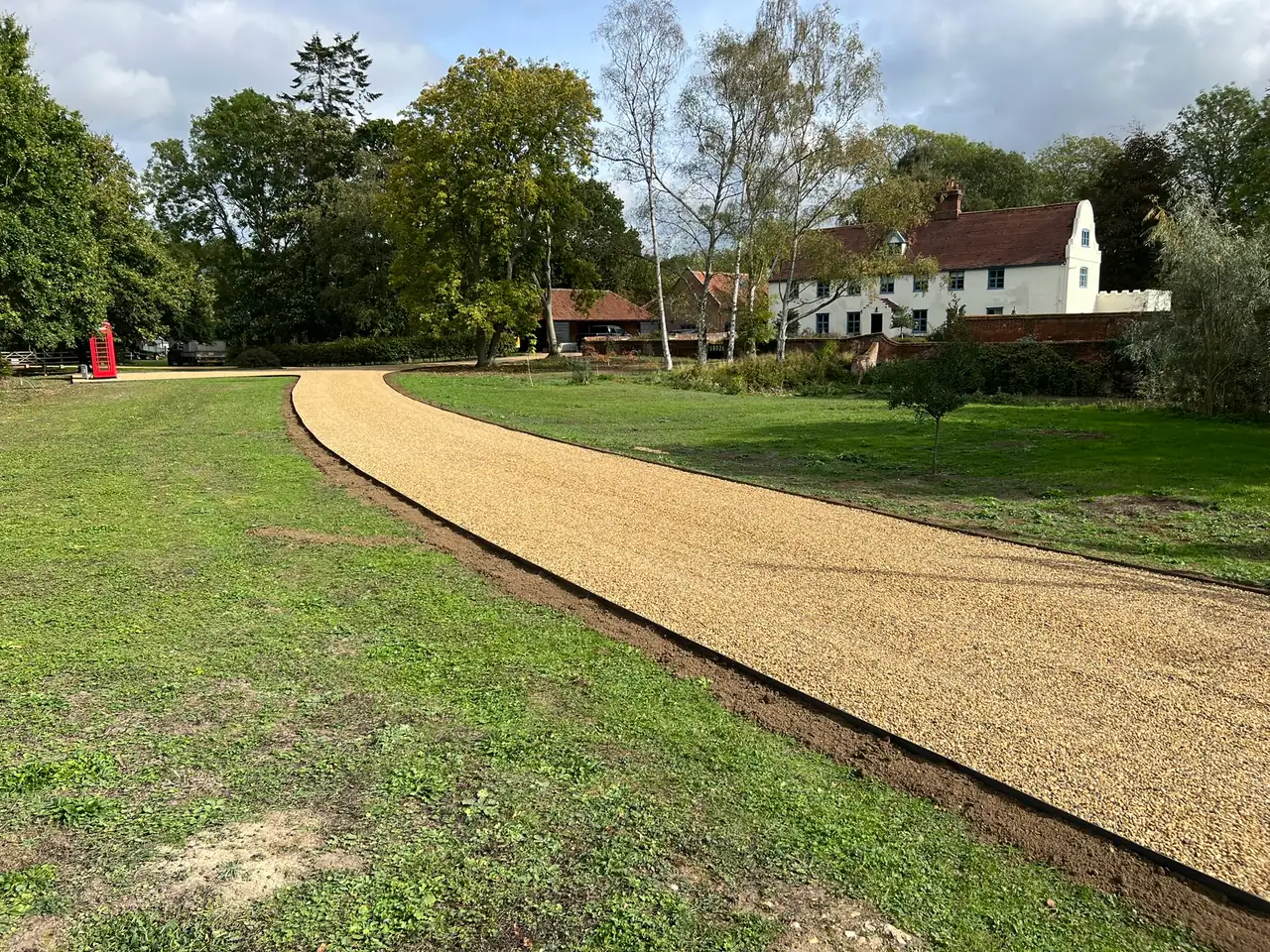
Autumn is the season that does the quiet damage. Nothing dramatic happens — no frost heave, no scorching — but leaves sit, drains silt up and moss gets its foothold while nobody's looking. An hour or two now saves a much longer job in spring.
Clear the leaves before they stain
Wet leaves left on a surface leach tannins, and tannins stain. On a pale aggregate — Golden Harvest, Ivory Coastal, a buff chip — a drift of oak or beech left for a fortnight will leave a brown shadow that takes real effort to shift. On darker surfaces it's less visible but just as real.
A sweep every week or two while the trees are dropping is all it takes. A stiff broom is fine on resin, tarmac and tar & chip. On block paving, work along the joints rather than across them so you're not dragging the sand out.
Check where the water goes
This is the one most people skip, and it's the one that matters most. Autumn is when gullies, channel drains and soakaways fill with leaf litter and grit — and a blocked drain in November becomes standing water in December and ice in January.
Lift the gratings, pull out what's collected underneath and flush them through with a hose. While you're there, look at where water runs during a downpour: it should be heading to a drain or a soakaway, not pooling against the house or sitting in a low spot on the drive.
The autumn list
Sweep leaves weekly while they're falling. Clear gullies and channel drains. Treat moss and algae before it spreads. Walk the edges and look for movement. Book any remedial work now, not in February.
Deal with moss and algae early
Norfolk autumns are damp, and the shaded side of a driveway — under a hedge, down the north side of the house — is where green growth starts. Caught early it washes off. Left until spring it beds in, holds water and turns genuinely slippery.
A gentle wash handles most of it. If you're using a moss treatment, pick one suited to the surface, follow the dilution, and keep it off planting. Resist the urge to blast it with a pressure washer on full: on block paving you'll strip the jointing sand, and on tar & chip you can loosen the surface stone.
Walk the edges
Edges are where a driveway tells you how it was built. Have a look along yours in good light: are the edging blocks still sitting true, or has one tipped out? Is there a gap opening up between the drive and the lawn? Has the lawn crept over the edge and trapped a line of soil and water against it?
Small edge problems are cheap to put right. The same problem after a winter of freeze and thaw usually isn't, because the water that gets in at a failed edge is exactly what lifts and cracks a surface.
Autumn is a decent time to lay, too
If you're thinking about new surfacing, early autumn is often an easier booking than high summer, and the conditions are still good. Resin and tarmac need dry ground and mild temperatures rather than heat — a settled September or October week suits both perfectly well. Block paving and gravel aren't fussy at all.
What we won't do is lay resin or tarmac into rain or a cold snap just to hit a date in the diary. It isn't worth it for the finish, and you'd be living with the result for years.
If something looks wrong
A dip that holds water, a crack that's opened up, an edge that's moved, a stain that won't lift — all of these are better looked at in October than in March. Get in touch and we'll come and have a look; it's usually a smaller job than people expect, and far smaller than it will be after a hard winter.