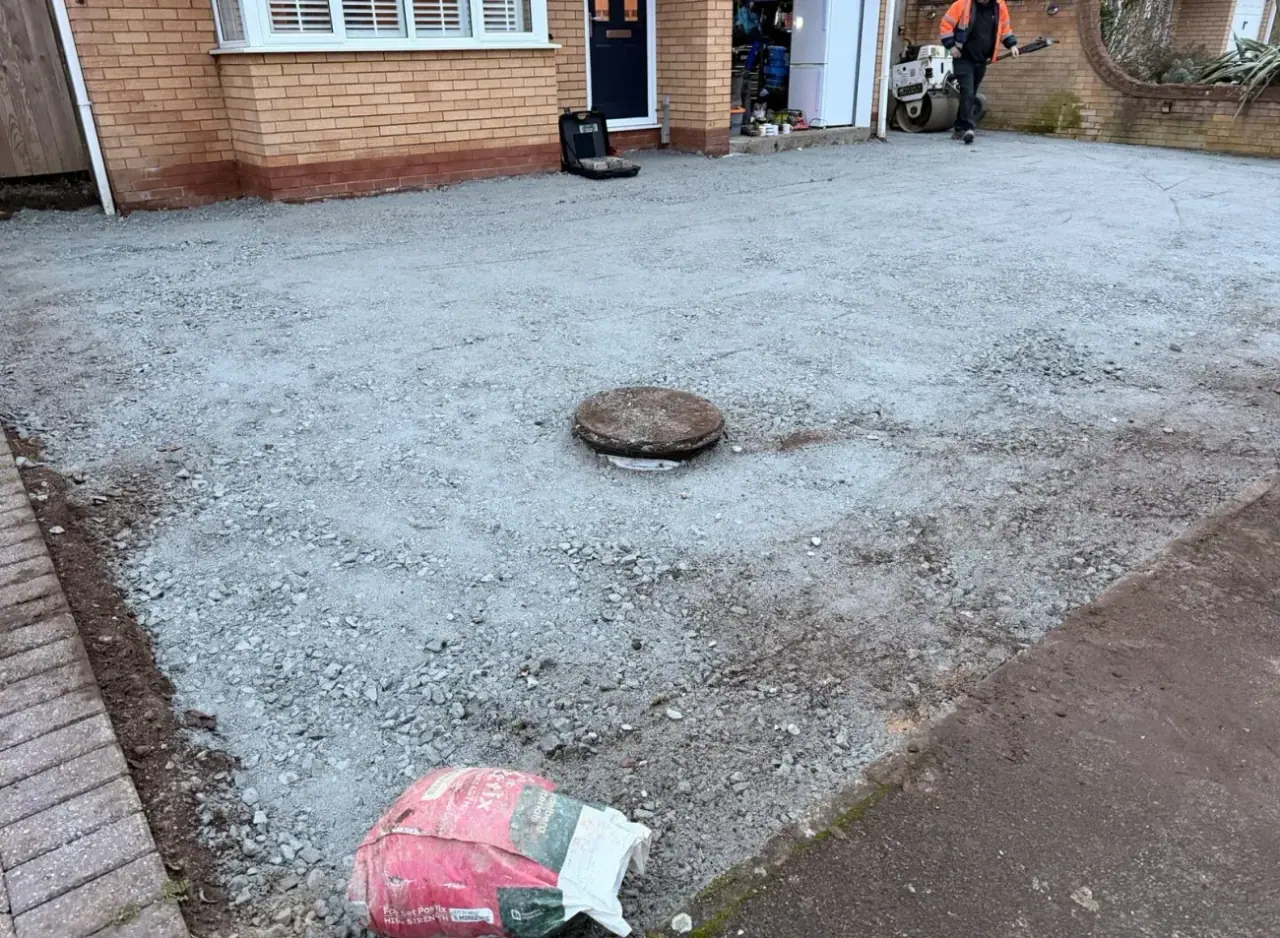
Driveways rarely fail in July. They fail in January — and when they do, the surface usually gets the blame. In our experience the surface is almost never the problem on its own. Winter just finds what was already wrong underneath.
Winter doesn't break driveways. Water does.
Cold on its own is harmless. What does the damage is water that has somewhere to sit and something to get into, freezing and thawing over and over. Each cycle opens the gap a fraction more and lets a little more water in next time.
So the question isn't really "how does this surface cope with frost?" It's "where does the water go, and what's holding the surface up?" Those two things are settled before a single square metre of resin or tarmac is laid.
Cause one: a sub-base that isn't deep enough
The sub-base is the compacted stone layer that actually carries the weight — the surface is just the wearing course on top of it. For a domestic driveway we'd normally want a well-compacted Type 1 layer of a sensible depth, more where the ground is soft or where vehicles turn.
Skimp on that depth, or tip the stone in and skip proper compaction, and the drive will feel fine for a summer. Then a wet autumn softens the ground, a car parks in the same spot every night, and by February there's a dip. The dip holds water, the water freezes, and now you have a crack as well.
This is the single most common corner cut in the trade, and it's invisible once the surface is down. It's also exactly why we don't subcontract the groundwork.
Cause two: nowhere for the water to go
Since 2008, new driveways in England have had to deal with their own surface water rather than running it onto the road. That's a planning rule, but it's also just good building: a drive needs either a permeable surface, a fall to a drain or channel, or a soakaway with the capacity to take what lands on it.
Where that's been fudged — a fall that runs towards the house, a channel drain with no real outfall, a soakaway too small for the area — winter is when you find out. Resin bound helps here because water drains through it rather than across it, but even a permeable surface needs ground beneath it that can accept the water.
The three things that decide it
Depth and compaction of the sub-base. Where the water goes — fall, drainage, permeability. Edge restraint that's properly haunched. Get those right and the surface looks after itself. Get them wrong and no surface will save you.
Cause three: edges with nothing holding them
Every surface needs something at the perimeter to stop it spreading sideways under load. Edging blocks or steel edging, bedded and haunched in concrete, do that job. Without it, the surface creeps outwards every time a wheel runs over it, a gap opens at the edge, water gets in at the gap — and the edge is where break-up almost always starts.
It's worth looking at your own: if there's a line of soil and moss between the drive and the lawn, or an edging block sitting proud of its neighbours, that's movement, and water is already getting in.
What this means if you're getting quotes
Two quotes for the same driveway can differ by thousands, and the difference is nearly always underneath. When you're comparing, ask each contractor the same three questions:
How deep is the sub-base, and what's it compacted with? Where does the surface water go? What's the edge detail? A contractor who can answer those plainly is pricing a driveway that will still be flat in ten years. One who changes the subject to colour choices is pricing something else.
And if yours has already gone
A drive that's cracked, dipped or broken at the edges can often be repaired — but it's worth finding out why it went before spending money on the surface again. We'll come and look, tell you whether it's a patch, a resurface or a rebuild, and say so plainly if the honest answer is the expensive one.