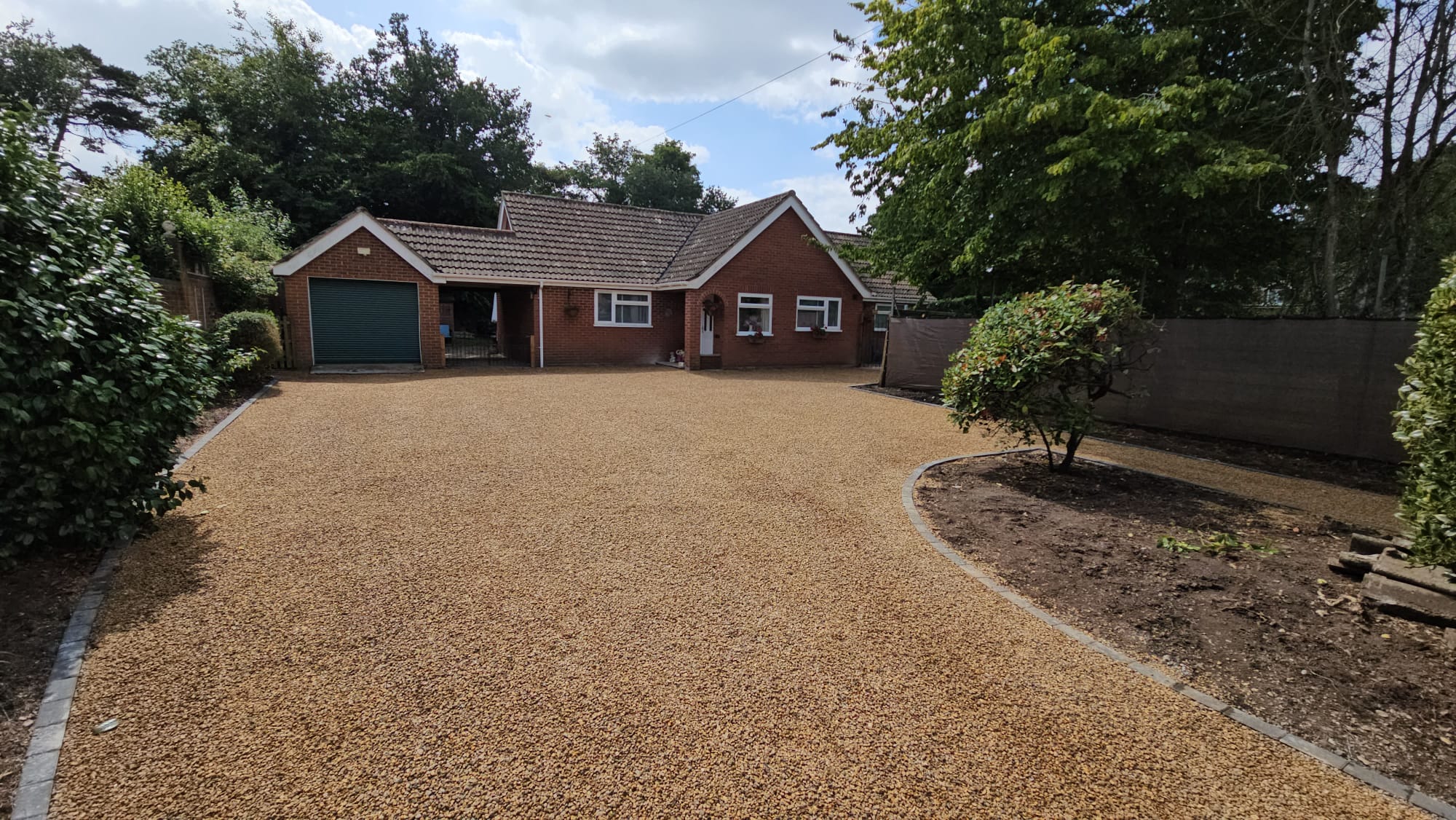
The affordable driveway comparison Norfolk homeowners need
Not every driveway needs to cost thousands of pounds per square metre. Gravel and tar & chip — also called chip and spray, or macadam surface dressing — are two of the most popular budget-friendly options in Norfolk, and they're often compared when homeowners want character without the premium price tag.
But they're very different surfaces. One is loose stone. The other is stone bonded into a tarmac base. Choosing the wrong one for your property leads to regret.
Gravel Driveways
What it is
A gravel driveway is exactly what it sounds like: a layer of loose stone aggregate, typically 25–50mm deep, laid over a compacted sub-base and a weed suppression membrane. The gravel is contained by edging — block kerbing, timber sleepers, or steel edging strips — to prevent it spreading onto lawns and roads.
Types of gravel
- Pea gravel — Small, rounded stones (10–20mm). Affordable but prone to scatter and difficult to walk on in heels.
- Self-binding gravel — A mix of aggregate sizes including fines that compact together. Firmer underfoot, less scatter, more road-like in feel. Our preferred choice for most driveways.
- Decorative gravel — Slate chippings, flint, or imported coloured stone. More expensive per tonne but striking in appearance.
Cost
Gravel is the lowest-cost driveway option: typically £15–30/m² for supply and installation, including sub-base preparation, membrane, and edging. The gravel itself is inexpensive — the cost is in the groundwork.
Drainage and SuDS compliance
Gravel is fully permeable — water passes straight through to the sub-base and soaks away naturally. It's the most SuDS-compliant surface available, requiring no planning permission for front gardens of any size. For properties in flood-prone areas of North Norfolk, this is a genuine advantage.
The scatter problem
The biggest practical issue with gravel: it moves. Cars drive it out onto the road; shoes carry it inside; it migrates to lawn edges. Good edging containment helps significantly, and self-binding gravel minimises the problem — but it never disappears entirely. If you have a busy, high-turning driveway, be prepared to rake and top up periodically.
Maintenance
Gravel needs topping up every 3–5 years as it thins through scatter and compaction. Weeds can establish if the membrane fails or was never installed. Raking to redistribute the surface is an occasional task — it's light work, but it's ongoing. Overall, gravel is low maintenance, but not zero maintenance.
Security benefit
One underrated advantage: gravel is loud. Anyone approaching your property on foot will announce themselves — an acoustic deterrent that solid surfaces don't provide.
Best suited to
- Rural and country properties where gravel is a natural aesthetic choice
- Large driveways where other surfaces would be expensive
- Driveways with low turning or reversing activity
- Period cottages and farmhouses
Tar & Chip Driveways
What it is
Tar & chip — macadam surface dressing — is a two-stage process. First, a layer of hot bitumen is applied to a prepared tarmac base. Then, stone chippings are scattered over the bitumen and rolled firmly in. The result looks like gravel but is bonded: the chippings don't scatter, don't need topping up, and provide a durable, textured finish.
Appearance
Tar & chip is visually warmer and more natural than plain tarmac. Available in a range of chipping colours — buff, golden, slate grey, red — it suits rural and period properties very well. It has a rustic, country-lane character that resin and standard tarmac can't replicate.
Cost
Tar & chip typically costs £25–40/m² installed — slightly more expensive than gravel but considerably less than resin or block paving. For large driveways of 100m² or more, it's an excellent cost-to-quality balance.
Drainage
Standard tar & chip has better drainage than plain tarmac (the open texture allows some water ingress) but it's not fully permeable and doesn't meet SuDS requirements without drainage provision. For front gardens subject to SuDS rules, a drainage channel or soakaway should be specified. Speak to your installer about sub-base drainage options.
Durability
A tar & chip surface typically lasts 7–15 years before re-chipping is needed. The base tarmac lasts considerably longer — the chipping layer can be refreshed without full replacement. This makes long-term ownership cost very reasonable: pay for a re-chip rather than a full new driveway.
Maintenance
Virtually none. Unlike gravel, there's no scatter, no raking, and no topping up. Weeds don't establish because there are no joints. An occasional power wash maintains the appearance. It's genuinely one of the lowest-maintenance surfaces available.
Best suited to
- Rural and semi-rural properties
- Homeowners who want the look of gravel without the hassle
- Large driveways where resin or block paving is too expensive
- Long, sweeping approaches to farmhouses and period homes
Head-to-head comparison
| Gravel | Tar & Chip | |
|---|---|---|
| Cost installed | £15–30/m² | £25–40/m² |
| SuDS compliant | Yes — fully permeable | Not typically |
| Scatter | Yes — ongoing issue | None — bonded |
| Maintenance | Moderate (raking, topping up) | Very low |
| Lifespan | Indefinite with topping up | 7–15 years before re-chip |
| Appearance | Natural, loose | Natural, textured |
| Noise | Loud — security benefit | Quiet |
| Underfoot feel | Loose (pea gravel) or firm (self-binding) | Solid and grippy |
Our recommendation
If you're choosing between gravel and tar & chip, we'll usually ask one question: how much do you mind raking?
Gravel is cheaper upfront and fully permeable — two genuine advantages. But scatter is a real problem on active driveways, and if you have mobility requirements or access needs, loose gravel is not ideal.
Tar & chip is our recommendation for most rural homeowners who want the natural look without the ongoing maintenance. You get a bonded, stable surface, excellent character, low day-to-day upkeep — and it's still very affordable. Many of our North Norfolk clients choose it precisely because it suits the landscape so naturally.
If budget is the primary driver and scatter doesn't concern you, self-binding gravel is a perfectly good choice. If you want the rustic look with proper stability and minimal effort, tar & chip wins every time.
Ready to get a quote from Norfolk's most experienced driveway specialists?
Get a Free Quote