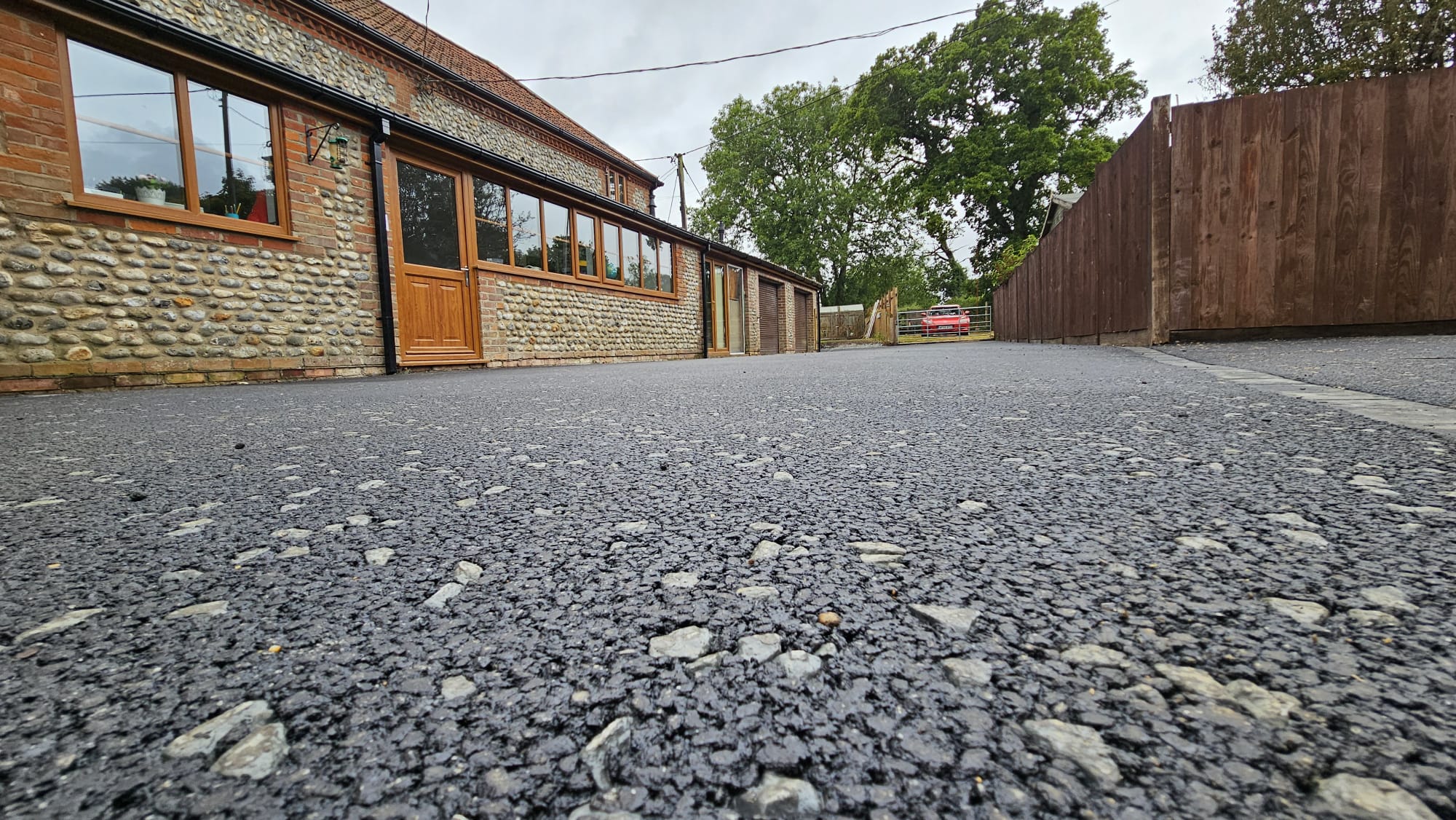
Two surfaces that look similar but perform very differently
From the end of your road, a resin bound driveway and a tarmac driveway can look almost identical — both dark, both smooth, both clean-edged. Get closer and the difference is obvious. Look at the specification and it's a completely different conversation.
Understanding what separates these two surfaces helps you make a smarter investment decision — and avoid the common mistake of comparing quotes for different specifications.
What is tarmac?
Tarmac (bituminous macadam, or bitmac) is a mixture of bitumen and aggregate, laid hot and compacted by a roller. It's been the dominant driveway and road surface in the UK for over a century for good reason: it's proven, durable, affordable, and quick to install. Standard tarmac is dense and impermeable — water runs off the surface rather than through it.
What is resin bound?
Resin bound surfacing bonds natural aggregate — stone, gravel, or recycled glass — within a UV-stable clear polyurethane resin. The mixture is applied over a prepared tarmac base and hand-trowelled to a smooth, seamless finish. The final surface is decorative and, crucially, fully permeable.
The key difference: permeability
This is the most practically significant difference between the two surfaces.
Resin bound, correctly installed over a permeable tarmac base, meets the government's SuDS (Sustainable Drainage Systems) requirements. This means:
- No planning permission required for front gardens, regardless of size
- Water drains through the surface rather than running off into the highway
- Reduced puddle formation in heavy rain
- Lower risk of contributing to local flooding
Standard tarmac does not meet SuDS requirements. For front gardens over 5m², standard tarmac technically requires planning permission (though enforcement is rare). Permeable tarmac — a more open-graded aggregate mix — does meet the requirements, but costs slightly more than standard tarmac.
Appearance
Resin bound wins on appearance, almost without exception. The range of aggregate options — natural stone, marble, recycled glass, quartz — means you can create a bespoke finish that complements your home's palette. The seamless trowelled surface has a premium, refined quality that's hard to replicate.
Tarmac is functional. Fresh black tarmac looks sharp and clean, and weathers attractively over time. But it's not decorative in the way resin bound is. Adding coloured chippings (tar & chip) adds character, though it remains a different aesthetic.
Cost
Tarmac is significantly cheaper: £25–40/m² installed, versus £60–90/m² for resin bound. On a 50m² driveway, that's a difference of roughly £1,750–2,500. On a 100m² driveway, the gap widens to £3,500–5,000.
The question isn't which is cheaper — it's whether the premium for resin bound is justified for your situation. For a front-facing driveway where kerb appeal matters, many homeowners find the answer is yes.
Lifespan
Both surfaces last 15–25 years when properly installed. Resin bound is more sensitive to installation quality — a poor resin mix or an inadequate base will fail early. Tarmac is more forgiving and can be patch-repaired or re-coated to extend its life significantly beyond the initial installation.
UV stability
Lower-quality resin products can fade or discolour in direct sunlight — a real concern. Quality UV-stable resins (the only type a reputable installer should use) resist this very effectively over the long term. Standard tarmac naturally weathers from black to dark grey over 1–2 years, which most homeowners prefer.
Edging requirements
Resin bound requires a solid edge restraint — typically block paving edging or a concrete haunch — to prevent the resin spreading or crumbling at the edges. This adds to cost but also creates a clean, defined border that many homeowners find improves the overall look. Tarmac can be haunched directly against a wall or kerb without additional edging in most situations.
Installation time
Tarmac is faster to install and usable within 24 hours of completion. Resin bound requires careful preparation, and the curing time means the surface shouldn't be driven on for at least 24–48 hours. Neither makes a meaningful practical difference for most homeowners, but it's worth knowing if timing matters.
When to choose tarmac
- Budget is the primary consideration
- The driveway is large (100m²+) where resin becomes expensive
- It's a rear, side, or access road where appearance matters less
- You want the most proven, repairable surface available
- Rapid installation is required
When to choose resin bound
- Kerb appeal and aesthetic quality are important
- The front garden is subject to SuDS planning rules
- You want a bespoke decorative finish that enhances property value
- The driveway is visible from the street
- You're prepared to invest for the best finish available
Our honest view
Both are excellent surfaces, and we install both every week across North Norfolk. The decision really comes down to what you want your driveway to do for you.
If functionality is the priority and the area isn't highly visible, tarmac is outstanding value. If kerb appeal matters — and for most front driveways, it does — resin bound delivers something that tarmac simply can't match. The investment difference is real, but so is the visual result.
What we'd caution against: choosing a surface on price alone without considering the SuDS planning implications for your property. A conversation with an experienced installer before you commit saves a lot of headaches later.
Ready to get a quote from Norfolk's most experienced driveway specialists?
Get a Free Quote