The hidden foundation that determines everything
When you get a quote for a new driveway, you'll be shown aggregate colours, finish samples, and completed project photographs. You'll almost certainly not be shown what goes underneath. Yet the preparation work beneath the surface — the layers you'll never see once the job is done — determines whether your driveway lasts 5 years or 25.
This is why driveway quotes vary so dramatically. Two quotes for the same surface at very different prices are almost always quoting different sub-base specifications. The cheaper quote is cutting corners underground, where you won't notice until it's too late.
The five layers of a properly built driveway
Layer 1: Excavation
Before any groundwork begins, the existing surface must be removed and the ground excavated to the correct depth. For resin bound or tarmac over a compacted sub-base, this typically means digging out 150–250mm below the finished surface level — more if ground conditions are poor (clay soils require deeper work), less if there's an existing solid base that can be retained and built upon.
Inadequate excavation is the most common corner cut on residential driveways. If the sub-base isn't deep enough, it will shift under vehicle weight, causing the surface above to crack and subside. You won't see the problem for 2–3 years, by which point the installer has long moved on.
Layer 2: Geotextile membrane
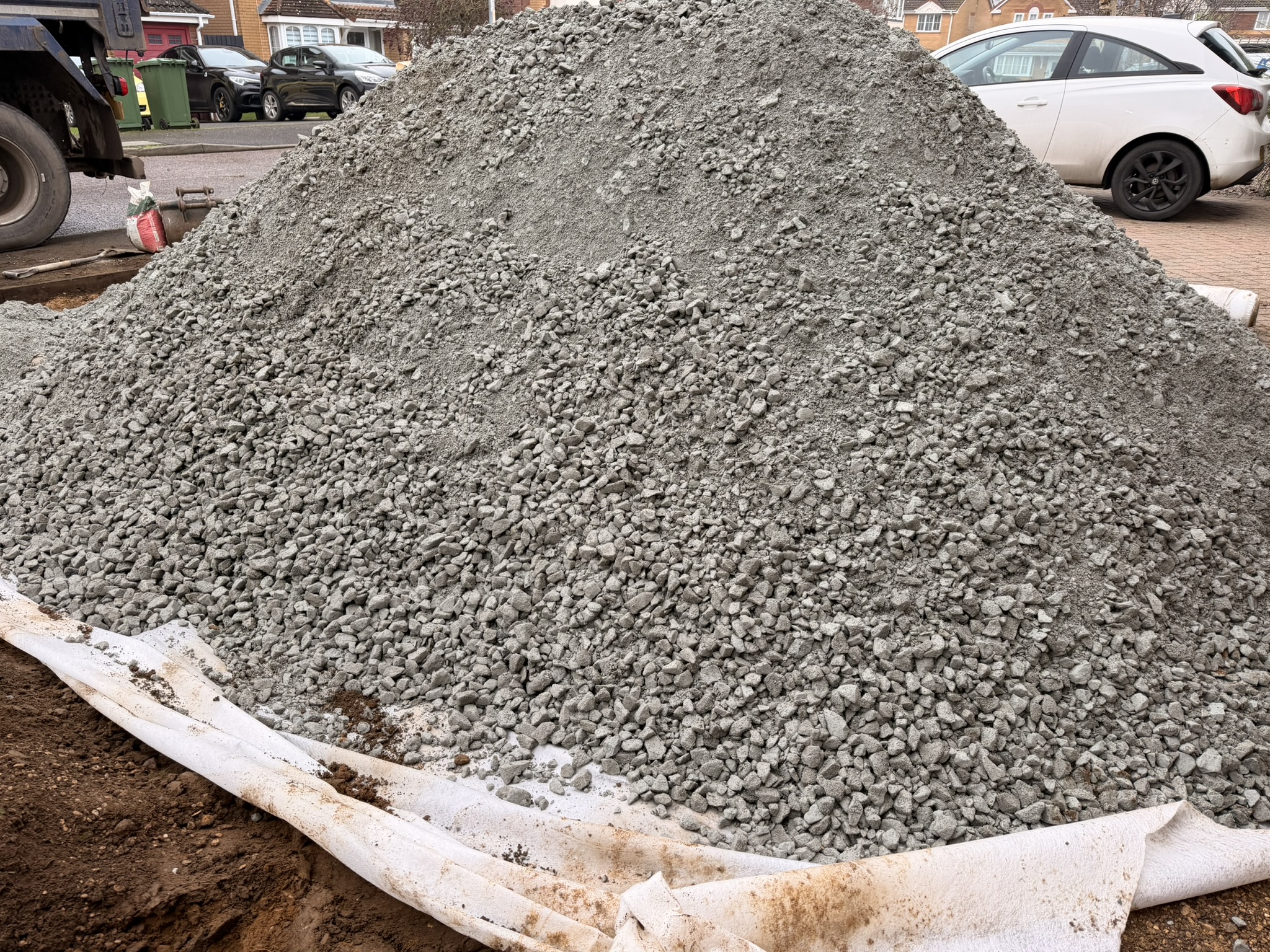
A heavy-duty woven geotextile membrane is laid on the prepared ground before the sub-base goes in. It serves two critical functions: suppressing weed growth from below, and preventing the sub-base from mixing with the clay or soil beneath — a process called "fines migration" that weakens the foundation over time.
Some installers skip this step entirely. It costs very little in materials and time, but makes a significant difference to long-term stability — particularly on clay soils, which are common across Norfolk.
Layer 3: Type 1 MOT sub-base
This is the structural heart of the driveway. Type 1 is a graded crushed stone — typically crushed limestone or crushed recycled concrete — that packs tightly when compacted. It's specified to the MOT Type 1 standard, meaning it meets the same specification used for road construction in the UK.
A properly installed sub-base should be:
- At least 100–150mm deep after compaction — deeper for clay soils or driveways that will carry heavy vehicles
- Laid in layers no more than 150mm thick — each layer compacted before the next is added
- Compacted thoroughly with a vibrating plate compactor (Wacker plate) to achieve a stable, uniform density throughout
- Graded to falls that direct water away from buildings — typically a minimum gradient of 1:60
When you see a driveway crack and subside — the classic wave pattern across the surface, or dips that collect standing water — the sub-base was almost always inadequately compacted or too shallow. No surface material can resist movement from below.
Layer 4: Tarmac binder course
Over the compacted sub-base sits a layer of bituminous macadam — typically 50–70mm deep. This is the binder course: a dense, stable base that provides a consistent platform for the final surface. For resin bound driveways, a permeable (open-graded) tarmac is used to allow water to drain through the full depth of the construction.
The binder course is rolled with a heavy roller to achieve a flat, even surface. Falls for drainage are refined at this stage. Getting this layer right is critical for resin bound in particular — any irregularity in the base shows through in the finished surface.
Layer 5: Surface material
Finally, the visible surface: resin bound aggregate, tarmac finish course, block paving on a sand bed, or whichever surface has been chosen. By this point, if the four layers below have been done correctly, applying the surface material is almost a formality. The structure is solid; the drainage is established; the surface just needs to be applied carefully.
This is also where the visible quality difference between installers shows — neat trowelling, consistent aggregate coverage, clean edges. But it's worth remembering: all the visual quality in the world won't save a driveway built on inadequate foundations.
What happens without proper preparation?
We see the results of inadequate sub-base work regularly across Norfolk. The failure patterns are consistent and predictable:
- Cracking: The surface fractures along stress lines as the ground beneath moves seasonally — particularly during freeze-thaw cycles. No surface material can resist movement from below.
- Subsidence: Areas of the driveway sink as the sub-base compresses under load. Often appears as "bowls" or channels following vehicle tracks.
- Edge failure: The edges of the driveway crumble first, as they have the least lateral support. Common in resin bound driveways with inadequate edge restraint.
- Drainage failure: Puddles form because the surface has shifted away from its designed falls. Water stands where it shouldn't, accelerating surface deterioration.
All of these failure modes are preventable. None of them are the fault of the surface material itself.
Red flags in driveway quotes
When comparing driveway quotes, look for these warning signs of inadequate preparation:
- No mention of excavation depth
- No mention of sub-base material or thickness specification
- Very low total price with no explanation of what's included
- A very quick promised turnaround — proper groundwork takes time
- "We can lay over your existing surface" without first assessing the base condition
- No mention of falls or drainage in the specification
What to ask your installer before agreeing
Before accepting any quote, ask these specific questions:
- How deep will you excavate?
- What sub-base material are you using, and to what specification?
- How thick will the sub-base be after compaction?
- Will you use a geotextile membrane?
- What falls are you building in, and where does the water go?
- What thickness is the binder course?
A confident, experienced installer will answer these questions immediately and in detail. Anyone who hedges, dismisses the questions, or can't answer is telling you something important about how they work.
Our approach
Every driveway we install starts with a site assessment to understand ground conditions. We specify sub-base depth based on the actual soil type — clay soils in North Norfolk require deeper preparation than free-draining sandy soils. We use Type 1 MOT sub-base, laid and compacted in proper layers, on every job we carry out.
Our quotes itemise preparation work clearly: excavation depth, sub-base specification and thickness, and drainage provision. If our quote is higher than a competitor's, we'll tell you exactly what we're including that they're not.
The foundation is the driveway. The surface is just what you look at.
Ready to get a quote from Norfolk's most experienced driveway specialists?
Get a Free Quote